There are a lot of strange sentences people say to each other in everyday life.
Things like:
“We should hang out sometime.”
“I read the terms and conditions.”
“I’ll just have one cookie.”
But somewhere near the top of the list is a sentence that people with chronic illness hear constantly:
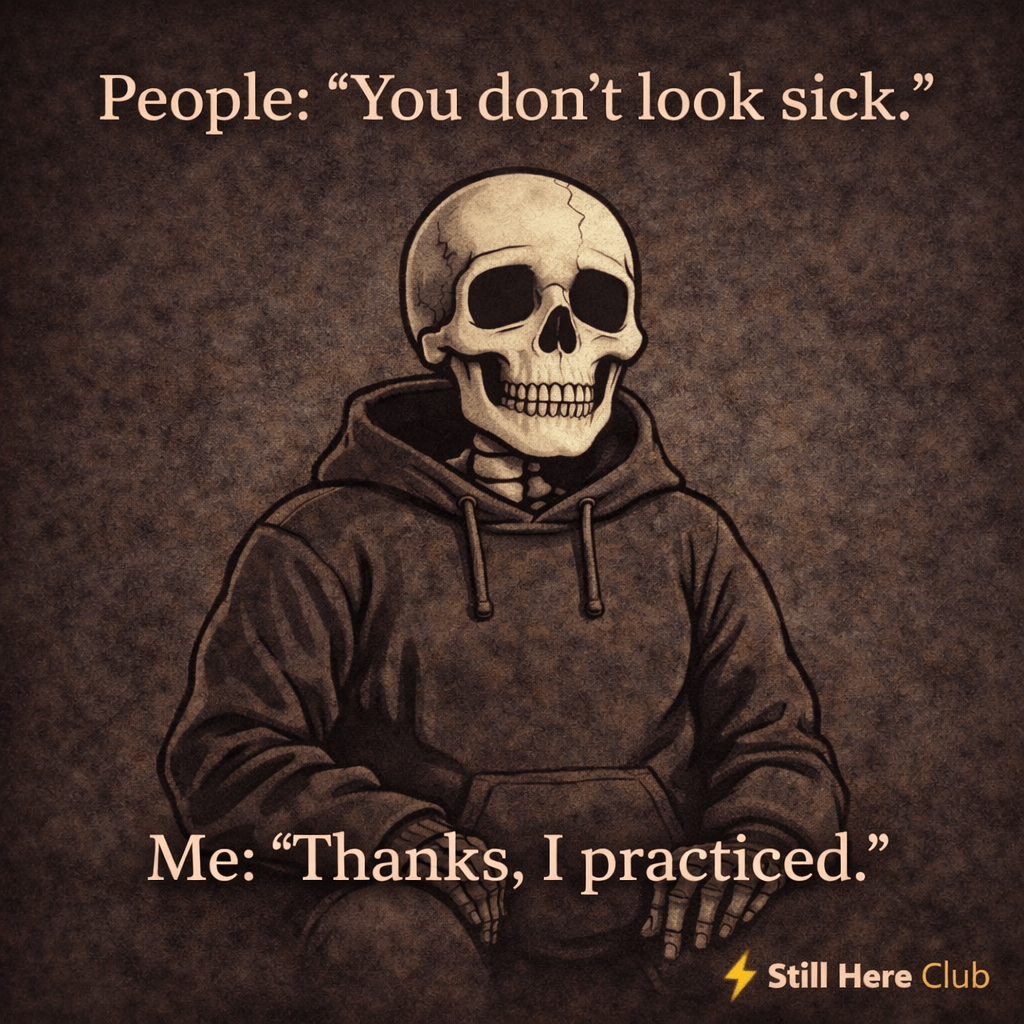
“But you don’t look sick.”
And every time someone says it, there’s a moment where the brain tries to process what that actually means.
Because when you stop and think about it…
…it’s a very strange sentence.
What Does Sick Even “Look Like”?
Apparently, society has a mental image of what a sick person is supposed to look like.
Maybe something like:
• pale and sweating
• wrapped in a blanket
• coughing dramatically
• holding a thermometer
• lying on a couch surrounded by soup and tissues
Which is fine if you have the flu.
But chronic illness doesn’t usually come with movie-style symptoms.
Most of the time people dealing with chronic conditions look like…
people.
People wearing normal clothes.
People walking around.
People smiling.
People going to work.
Meanwhile inside their body things might be happening like:
• severe fatigue
• chronic pain
• autoimmune chaos
• nervous system malfunctions
• digestive systems doing interpretive dance
But sure.
Because they’re not visibly collapsing in the grocery store, they apparently look fine.
The Invisible Illness Problem
A huge number of medical conditions are what’s called invisible illnesses.
Meaning they don’t come with obvious outward signs.
Examples include things like:
• autoimmune disorders
• chronic fatigue conditions
• neurological disorders
• digestive diseases
• chronic pain conditions
• many mental health conditions
The symptoms are real.
The impact is real.
But to someone looking from the outside, it’s easy to assume everything is normal.
And that’s how people end up saying:
“You don’t look sick.”
Usually followed by an awkward pause.
The Professional Skill of “Looking Fine”
Here’s something people outside the chronic illness world may not realize.
Many people with long-term health issues become experts at looking fine.
It’s a survival skill.
You learn how to:
• push through exhaustion
• mask pain
• smile when you feel terrible
• function on very low energy
Sometimes it’s because you have to work.
Sometimes it’s because explaining everything is exhausting.
Sometimes it’s because society isn’t exactly great at understanding complicated health situations.
So yes.
A lot of people don’t look sick.
Because they’ve spent years learning how to function while feeling terrible.
It’s basically a very unfortunate superpower.
The Reality Behind the Smile
Someone might look perfectly okay while they’re:
• managing severe fatigue
• recovering from surgery
• dealing with chronic pain
• taking medications with side effects
• trying to make it through the day with limited energy
But none of that shows up on the outside.
What you see is the version of them that is trying their best to keep going.
And honestly, that’s impressive.
Because continuing to function while your body is throwing tantrums is not easy.
What People Usually Mean
To be fair, most people who say “You don’t look sick” aren’t trying to be rude.
Usually they mean something more like:
“I’m surprised.”
or
“I didn’t realize.”
But the wording still lands strangely.
Because it implies that illness should be visibly obvious.
And that’s just not how many conditions work.
The Classic Response
People in the chronic illness community often respond with a little humor.
One of the most popular replies is:
“Thanks. I practiced.”
Because honestly, that’s the truth.
Looking fine sometimes takes a lot of practice.
A Different Way to Think About It
Instead of judging illness by appearance, it’s often better to remember something simple:
Not all struggles are visible.
Someone might look completely normal while quietly managing something incredibly difficult.
And the fact that they’re still showing up, still participating in life, still pushing forward…
That deserves a lot more respect than suspicion.
Welcome to the Still Here Club
The Still Here Club exists for people who have been through things the outside world doesn’t always understand.
People who have survived illness, surgery, trauma, or life circumstances that forced them to adapt.
Some of those stories are visible.
Many are not.
But every member of this club has one thing in common.
They’re still here.
And sometimes that’s the most impressive thing of all.
⚡ Membership: Earned.
 Still Here Club — Chronic Illness Humor & Resilience
Leave a comment